As opportunity youth continue to struggle to connect to the economy, entrepreneurship offers a chance for them to learn the skills and mindset needed to thrive in today’s economy. Opportunity youth, the 4.6 million young people who are neither in work nor in school, often encounter significant barriers to education and employment, and entrepreneurship programs may offer solutions to the challenges they face.
Through the Opportunity Youth Forum (OYF), the Forum for Community Solutions (FCS) works with a network of over two dozen urban, rural, and tribal communities seeking to reconnect opportunity youth to employment and education opportunities. FCS looks for myriad ways to create these pathways, which was the basis behind the launch of the Youth Entrepreneurship Fund (YEF) in 2017.
Through funding support from the Charles Stewart Mott Foundation, YEF responded to the interest expressed by OYF communities and youth leaders in exploring entrepreneurship as a pathway to economic self-determination and wealth-building in low-income communities.
The YEF seeks to promote racial and economic equity by ensuring that youth experiencing barriers to participation in the economy – including youth of color, Native American, and rural youth, as well as youth who are low-income and reside in public housing – are provided with a full range of opportunities to develop an entrepreneurial mindset and skills that can help them thrive in today’s economy, as well as access to tools and resources needed by aspiring entrepreneurs.
A new publication, Creating Entrepreneurship Pathways for Opportunity Youth, co-written with FIELD at the Aspen Institute, examines the potential for using these YEF programs to engage and create pathways for opportunity youth by exploring results from OYF communities that received YEF grants and have entrepreneurship initiatives now in progress.
Mali Linton, 22, worked with Bay Area Community Resources (BACR) and HOPE SF Initiative last year and said the experience allowed her to acquire knowledge she couldn’t have learned on her own.
The focus in the Bay Area provided entrepreneurial education, mentoring, financial literacy training, business development classes, and wrap-around supports to youth residing in public housing, who are among the most marginalized of San Francisco residents and do not have a path into the rich entrepreneurial ecosystem of the city.
"I learned how to be creative and innovative while building my business from the ground up," Mali says. "I’ve also learned that entrepreneurship isn’t for everybody. I had to be comfortable being uncomfortable a lot."
One of the goals of the YEF is to not just teach young people the tools to create businesses, but to use entrepreneurial education to develop skills that can support them in whatever career they choose.
"People starting their own businesses start to feel empowered, they believe in themselves and their ability to take control of their destiny," he says. "I’ve seen entrepreneurship spark excitement in the eyes of these young people, the ability to be their own boss and make their own money goes hand and hand with the street mentality we develop in our community."
Feb 20, 2019
Jan 3, 2019
Canadian higher education in review
Mental health on campus
What role do faculty have in supporting student mental health? How should university administrators respond to reports of worrisome behaviour on campus? Questions on the perennial issue of mental health never seem to fade, especially as demand for help on campus rises. In this vein, our writers have also discussed the emotional toll of teaching, cultivating resilience in students and an appeal to professors to err on the side of trust when it comes to sick notes.
Cannabis policies
It is hard to ignore the sweeping impact cannabis legalization has had on many sectors, including higher-ed. Before the law was set to take effect, researchers were gearing up to track the social, economic and health effects of this historic change in public policy. Universities were in a pinch to come up with campus cannabis policies with the onset of a new academic year. And, student journalists at four institutions took notice of the complicated patchwork of guidelines in place.
Equity, diversity and inclusion
The federal government has made no secret of its interest in bringing about change in equity, diversity and inclusion in research. For a long view of gender and full-time faculty in Canada, here are six charts that tell a partial history. This past summer, after the launch of the Canada Research Coordinating Committee, consultations began on the new $275-million tri-council fund, which included discussions of EDI. Consultations also kicked off for a ‘made-in-Canada’ Athena SWAN program, which will go beyond gender equity, and NSERC aims to unveil details of a pilot in 2019. With the federal budget coming up in the spring, university groups have EDI on their radar as well in their pre-budget submissions.
Reckoning with reconciliation
“Reconciliation” was always a hefty word with action needed to back it up. In response to the Truth and Reconciliation Commission’s calls to action, universities continue to work toward a shared commitment to closing the Indigenous education gap. One of those efforts: law schools are revamping their programs to respond to what one dean calls “the most significant shift in the Canadian legal landscape in our lifetimes,” Kerry Banks reports. Columnist Sheila Cote-Meek remarked on the need for structural changes at universities rather than quick fixes that don’t stand the test of time. And, at the most recent Building Reconciliation Forum, the theme was Ts’its’u’ watul tseep, meaning “to help one another” in the HUL’Q’UMI’NUM’ language.
Dec 3, 2018
Poem of the week: Sonnet – September 1922 by Ivor Gurney
Sonnet – September 1922 isn't quite, at first glance, the kind of poem we associate with Ivor Gurney. He was a consummate poet of place and particularity, celebrating in The Dearness of Common Things a litany of domestic and pastoral favourites, from "Beech wood, tea, plate shelves / And the whole family of crockery" to "Earth fine to handle, / The touch of clouds" and "Wool, rope, cloth, old pipes / Gone warped in service / And the one herb of tobacco". A song of self-knowledge, that candid statement of his ars poetica underlies a previous poem of the week by Gurney, The Mangel-Bury. This week's choice doesn't turn its back on the resources of place and detail, but layers them with more abstract ideas.
Even before a traumatic experience of the first world war, Gurney showed symptoms of the illness that would lead to his hospitalisation, and which would now very likely be categorised as bipolar disorder. The dating of the poem strongly suggests that he wrote it around the time he was certified insane. It was written on 28 September, in the same year that Gurney was transferred from a mental asylum in his native Gloucester to the City of London mental hospital in Dartford, Kent, where he was to spend the last 15 years of his life.
His real life as a poet was to continue, and the decision to write in the sonnet form at this intensely emotional moment signals, perhaps, a quiet mustering of resources. Authenticity, realised through innovative formalism, is the first of these.
The sestet complicates the thought, and concerns self-perception. As the earth "Forgets protestation in its turning", the toad, threatened by the harrow, forgets or is forgotten by "toadiness"– the state of being a toad, but, implicitly for the person in that crushed condition, the dishonourable state of playing the toady. The sense of self is undermined more radically in the butterfly's reaction "when that clanking thing goes by" (the harrow, the ambulance?) but then rectified ("And's not distressed"). The last two-and-a-half lines shift magnificently to the metaphorical and colloquial, introducing, with a characteristic wry, down-to-earth humour, the grocer's easily falsified bill. While being "twisted" physically connotes painful distortion and death, acquiescence might include possibilities of self-preservation and even escape (twisting free). The concluding aphorism mingles gravity and insouciance. Protest fails: time is handed the natural victory, which might also bring a welcome cessation of mockery or betrayal, "And no history of November keeps the guy."
Nov 9, 2018
Culture secretary Jeremy Wright reveals his love of Lego
The culture secretary, Jeremy Wright, has said he has a large Lego collection, which he uses to relax when in need of a break from the rigours of government.
"In my view, it’s a great way of putting your brain into neutral, which sometimes we all need to do," he said, describing his Lego collection. "It’s very large indeed. My wife would say far too large but I find Lego therapeutic," the Conservative MP told talkRADIO.
"I think everybody who does any difficult or stressful job needs a way to switch off. We all have different ways. Mine is Lego."
Wright said he had built a recreation of the Death Star from Star Wars using 4,500 bricks. "Putting Lego together and pulling it apart again is a very therapeutic process. Some of the new stuff is very good and the engineering capabilities of those who build and design Lego sets is quite amazing."
Earlier this week, Wright, who is responsible for overseeing the media industry, told a meeting of newspaper editors that he did not subscribe to any British newspapers or magazines. Instead, he relied on a summary of the news from his aides.
The digital, culture, media and sport secretary, who did not have an active Twitter account when he took the job, insisted his comments had been misinterpreted to suggest he didn’t consume any news: "To suggest that I don’t read newspapers is complete nonsense. Of course I do."
Michael LeCount, the owner of the Lego shop Bricks and Bits in Sheffield, told the Guardian that Wright’s hobby was not unusual: "There is quite a big community of adult fans who are into Lego or have come back to it."
Their extra spending power enabled them to build larger collections and buy themed Lego sets based around films or comic book series.
In recent years, Lego Serious Play workshops had become a regular feature at corporate and government team-building events, encouraging individuals to work together creatively.
LeCount said adults had always been drawn to making models and Lego meant "you can create what you want, you don’t have to be constrained".
"It’s partly a nostalgia thing – they remember having it as a child – and the sets they’re doing are more appealing to adults," added LeCount, who earlier this year bought a second home to house his Lego collection.
Sep 27, 2018
The warm glow of kindness is real, study confirms
Psychologists at the University of Sussex have confirmed that the warm glow of kindness is real, even when there's nothing in it for you. In their study, published in NeuroImage, they undertook a major analysis of existing research showing the brain scans relating to over 1000 people making kind decisions. For the first time, they split the analysis between what happens in the brain when people act out of genuine altruism—where there's nothing in it for them—and when they act with strategic kindness—when there is something to be gained as a consequence.
Many individual studies have hinted that generosity activates the reward network of the brain but this new study from Sussex is the first that brought these studies together, and then split the results into two types of kindness—altruistic and strategic. The Sussex scientists found that reward areas of the brain are more active—i.e. use up more oxygen—when people act with strategic kindness, when there is an opportunity for others to return the favour.
"This major study sparks questions about people having different motivations to give to others: clear self-interest versus the warm glow of altruism. The decision to share resources is a cornerstone of any cooperative society. We know that people can choose to be kind because they like feeling like they are a 'good person', but also that people can choose to be kind when they think there might be something 'in it' for them such as a returned favour or improved reputation. Some people might say that 'why' we give does not matter, as long as we do. However, what motivates us to be kind is both fascinating and important. If, for example, governments can understand why people might give when there's nothing in it for them, then they can understand how to encourage people to volunteer, donate to charity or support others in their community."
"The finding of different motivations for giving raises all sorts of questions, including what charities and organisations can learn about what motivates their donors. Some museums, for example, choose to operate a membership scheme with real strategic benefits for their customers, such as discounts. Others will ask for a small altruistic donation on arrival. Organisations looking for contributions should think about how they want their customers to feel. Do they want them to feel altruistic, and experience a warm glow, or do they want them to enter with a transactional mind-set?"
"The same issues could also apply when we think about interactions between family, friends, colleagues or strangers on a one-to-one basis. For example, if after a long day helping a friend move house, they hand you a fiver, you could end up feeling undervalued and less likely to help again. A hug and kind words however might spark a warm glow and make you feel appreciated. We found some brain regions were more active during altruistic, compared to strategic, generosity so it seems there is something special about situations where our only motivation to give to others is to feel good about being kind."
Aug 13, 2018
Language Corner offers chance for learning, cultural exchange
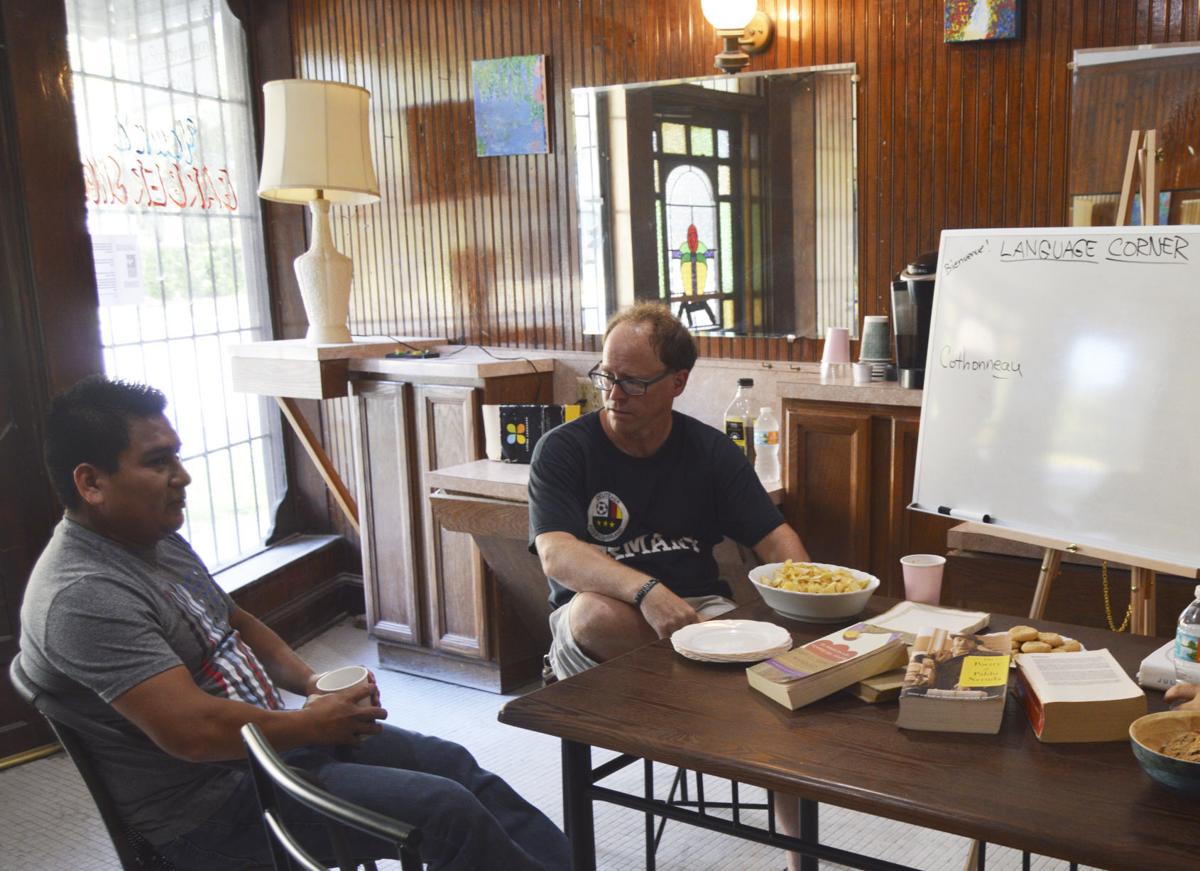
Jeff Cuttino's face lit up as the door opened and new faces stepped inside.
"Bienvenidos," he exclaimed with a smile as the attendees entered.
The greeting was happily returned as more joined the group already assembled around the table at the former barber shop turned Study on Union Street in downtown Brunswick.
Cuttino began making introductions in Spanish, pointing to those already situated around tables at the regular meeting of the Language Corner. Cuttino's wife, Sheri, smiled as she greeted the newcomers.
It's a scene that the Cuttinos hope will be repeated and even grow with time, as the group they recently started, the Language Corner, begins to take shape. The idea of learning a new language and offering a cultural exchange first began when the couple was living in Atlanta before relocating to the Golden Isles.
"We first went to the Conversation Cafe in Atlanta, where you would go and they would have coffee and snacks. You would put a name tag on with your name and the language you wanted to speak," Sheri explained. "Jeff was really into Spanish and I didn't know much Spanish. I knew a little French. So I spoke English but there were people there who wanted to practice English. It was just really neat."
The group brought together individuals from all over the world to interact and engage with one another. The goal for each was the same — learning or becoming more proficient in a language.
"They would also share how they learned a language. For example, those who were Spanish speakers learned English by watching movies or listening to the radio. They suggested that you do the same to learn Spanish," she said.
It is a concept they hope to bring to Brunswick. That's why they recently formed the Language Corner, which will meet from 6-8 p.m. every Wednesday at 1425 Union St., Brunswick. There, the Cuttinos will welcome those who want to interact in various languages in a relaxed environment.
While they haven't had many meetings, the group is already drawing interest.
"We have some people who speak French and who speak Spanish come. We have a French table and a Spanish table," Jeff Cuttino said, gesturing to the tables. "We have someone who speaks German too."
Each person who attends has his or her own reason for wanting to learn or improve their skills with a new language.
For Reuben Hernández-Artero, it is to feel more at home here. A native of El Salvador, he and his family relocated and he has been spending time with the Cuttinos to help him feel more comfortable with English.
"Reuben's reason is different than my reason of course. My motivation is that I just think it's fun," Jeff said. "But we met through the school I teach at ... and we started having them over for dinner. I will speak Spanish to him and he will correct my mistakes. I will do the same for his English. We help each other."
It offers a non-judgmental space for a language exchange, allowing speakers to use the words they don't in every day life. The knowledge and confidence is especially helpful when traveling, Sherri adds.
"We went to Paris and we got lost but we were comfortable enough to speak French and ask questions. They could understand us which was great," Sheri said.
"A lot of people speak English there but it's just nice to be able to go and at least try."
It's also a way to break down barriers, she notes.
"I know when I hear people speaking a different language that I don't understand ... you kind of think they might be talking about you — they aren't, but you think that," Sheri said with a laugh.
"But when you understand it and you feel confident to respond or speak to them, they are actually pretty impressed."
The same is true of people who move to America from foreign countries.
Having native English speakers willing to try to converse in Spanish is a welcoming and meaningful effort, Hernández-Artero said.
"That has happened to me and friends of mine too ... when you are speaking Spanish and an American comes over to you and they speak it and they speak it very well. You think ‘wow that's amazing,'" Hernández-Artero said.
Jul 18, 2018
Learning first generation
Whenever I am asked the questions"What are you?"or"What ethnicity are you?"I always pause before replying. Having been born in America,I want to reply,"American."I celebrate the Fourth of July every year,listen to American pop music,attended American schools my entire life and grew up chasing after the American dream. However,because my Indian heritage can be traced for generations and because of how much Indian culture is a part of my day-to-day life,it also makes sense to me to reply,"Indian."I mean,I cannot count how many times I have begged my parents to take me to the Indian grocery store so that I could have kulfi or the number of pictures I have taken in traditional Indian clothing. Further,based on my appearance,people usually judge that I am Indian. So,feeling that both places are equally a part of me,I usually settle on"Indian American.”
There is no easy answer to those questions,just as there was no easy answer for me as I navigated being a first-generation Indian American growing up.
"You can't trust boys,"my mom would repeatedly tell me. Yet right after,she would turn to tell my brother,"You can't trust girls."I remember finding this funny growing up,but I never questioned it to my parents' faces. Both hailing from small villages in India,my parents had for the most part studied in schools that were single-gender. To send their kids to coeducational public schools here was an adjustment. When it came to play dates,they would encourage me to only have girl friends over,and when it came to school projects,they thought it best for me to choose girl partners.
When I started high school,I chose to go out for various extracurriculars that my school hosted. But to my parents,my focus should have been mainly,if not solely,on academia. It was there where I would get the most returns on my efforts. Despite these expectations,I went into high school open-minded. I was on my school's tennis team. I was an editor for my school paper. I joined service organizations. And while all these activities were draining,they were also what made my high school experience worthwhile — something that I think my parents see now,realizing how these experiences have helped mold me into the person I am today.
In my 10th-grade honors English class,I was assigned to read"The Joy Luck Club"by Amy Tan. Initially,I saw how thick the novel was and was scared off. We'd have a reading comprehension test on the material later,and if the material was dense,I knew I would have trouble. Yet this was not the case.
The book was on Chinese immigrant families who start the Joy Luck Club,where the woman play mahjong,and cook traditional food. This scene reminded me of my own small gatherings,where my aunts and uncles would exchange conversations about work and life with each other over traditional desi food.
These stories of daughters and their interactions with their mothers were extremely relatable. In the novel,Jing-Mei Woo talks of her mother's unwavering faith in her despite her failures. When her mother gifts her her old piano even after a failed recital,the narrator is unsure if she can play again,yet her mother pushes her anyway. The feeling of not believing in myself to the extent that my parents did was one that I could relate to.
My mother has shared that same unwavering belief in me,even when I have not believed in myself. In first grade,I had gotten third place in my class spelling bee,misspelling"direction"as"direccion."I ran into her arms crying,swearing that I would never attempt a spelling bee again. Yet she was calm,encouraging me anyway. Next year would be my year,she promised. She started giving me dictations to help me practice my spelling,and the next year,I did in fact win my class spelling bee. Reading the stories of other first-generation Americans has helped me realize that my experiences are not unique to me. They are universal,even if they are not national.
I understand the troubles my parents had raising my brother and me,having to move from a small village in India to a place that was foreign and different. The values that they brought with them were conservative,and helping them to see that certain aspects that were unique to American culture did not necessarily entail bad consequences for us children has been difficult. I mean,having a guy lab partner was not the end of the world,and neither was losing a spelling bee. I learned to find a harmony,showing my parents that I still respected their culture and cherished our roots while assimilating to life in America.
Subscribe to:
Posts (Atom)