May 11, 2012

Introvert Does Not Matter Much In Your Life, Just Be Happy

Introvert
I wrote this list in late-2008. Around that time, I was lucky enough to discover a book called, The Introvert Advantage (How To Thrive in an Extrovert World), by Marti Laney, Psy.D. It felt like someone had written an encyclopedia entry on a rare race of people to which I belong. Not only had it explained many of my eccentricities, it helped me to redefine my entire life in a new and productive context.
  
Sure, anyone who knows me would say, “Duh! Why did it take you so long to realize you’re an Introvert?” It’s not that simple. The problem is that labeling someone as an Introvert is a very shallow assessment, full of common misconceptions. It’s more complex than that.
  
A section of Laney’s book (page 71 through page 75) maps out the human brain and explains how neuro-transmitters follow different dominant paths in the nervous systems of Introverts and Extroverts. If the science behind the book is correct, it turns out that Introverts are people who are over-sensitive to Dopamine, so too much external stimulation overdoses and exhausts them. Conversely, Extroverts can’t get enough Dopamine, and they require Adrenaline for their brains to create it. Extroverts also have a shorter pathway and less blood-flow to the brain. The messages of an Extrovert’s nervous system mostly bypass the Broca’s area in the frontal lobe, which is where a large portion of contemplation takes place.
  
Undervaluing extroversion. Spending time alone and with people are equally important. If you’re very introverted, you may undervalue the positive role people can play in your life, such as knowledge, friendship, growth, laughter, and so on. The optimal outcome is to strike a balance between the two. You don’t have to give up the introvert activities you enjoy. In fact, when you balance them with more social activities, you’ll probably find them even more satisfying. After several nights of being around people, I really look forward to a night by myself to read, meditate, write, etc. And after lots of time alone or with my family, I’m itching to go out and be around other people.
  
Underdeveloped social skills. Social skills can be learned like any other skill set. One reason introverts shy away from social activities is that they don’t feel comfortable because they don’t know what to do, especially if the unexpected were to occur. Being able to start up a conversation with a stranger AND feel completely comfortable doing it is a learnable skill. The more you do it, the better you get at it. Embrace the fact that you’re a beginner, and don’t compare yourself to others.
  
Envisioning yourself as the wrong kind of extrovert. If you find the extroverted people around you shallow and perhaps even annoying, why would you want to be more like them? You wouldn’t. When I was a kid, I really didn’t want to be more like the extroverts I knew. Even as an adult, my vision of an extrovert was an in-your-face salesperson who only wanted to build a shallow relationship with you so they could sell you something. It seemed very fake and phony to me. And of course that vision prevented me from ever wanting to be like that. But you needn’t choose such a limited vision for yourself — you’re free to form your own vision of a positive way to be more extroverted.
  
Hanging out with the wrong people. Why would you want to spend more time with people you don’t like? If becoming more extroverted means spending more time with people you’d rather avoid, you’ll have no motivation to do it. Again, you’re free to break this pattern and form a social group that you’d love to be a part of.
  
Overvaluing online socializing. Online socializing has its place in your life, but it’s a pale shadow compared to face-to-face, belly-to-belly communication. Voice and body language can communicate a lot more than text, and emotional bonds are easier and faster to establish in person. I feel much closer to the local friends I’ve known for only a few months than I do to the people I’ve known online for years but never met in person. It’s just not as fun going out to dinner with a laptop. You don’t have to do away with online socializing, but don’t allow it to crowd out meeting people locally. If you do that, you’ll only cause your interpersonal skills to lag further behind.
  
If you have some of these blocks and want to get past them, the first step is to acknowledge them and consider how they’re holding you back. Then begin to work on them just as you would any other challenge in your life. Focus your intentions, set goals, make plans, and start taking action. It may be awkward and clumsy at first, but just accept that, and get moving anyway.
  
Assert yourself as a legitimate personality type.
  
There are two legitimate personality types: extroverts and introverts.2. Correct people when they refer to introverts as neurotics.
  
Introverts are not neurotics. They are introverts.3. Correct people when they refer to introverts as prone to mental illness.
  
Introverts are no more prone to mental illness than others. When extroverts are under stress, they overeat, smoke, drink and become violent. When introverts are under stress, they withdraw. This does not make them mentally ill.4. Correct people when they assert that introverts are anti-social.
  
Introverts are not anti-social. They are drained by other people and must limit their time in company, but they are friendly and loving people.5. Correct people when they assert that introverts have nothing to say.
  
On the contrary, introverts won’t speak unless they have something important to say! Put a proper value on your ability to be a good listener.
  
Good listening skills are invaluable in all areas of business and industry.7. Do not apologize for time spent alone.
  
Explain to critical “others” that introverts need to spend at least half their time alone for good mental and emotional health. Then assert, if necessary, that introverts are a legitimate personality type.8. Introverts are not losers.
  
Take pride that you are in the company of such introverts, past and present, as Albert Einstein, Steven Spielberg, Queen Elizabeth II, Charles Darwin, Mahatma Gandhi, Michael Jordan and Bruce Lee.9. Stand up for introverted children who are being misunderstood in your presence.
  
This is one of the most healing things you can possibly do for yourself as it will heal your own inner child.10. Don’t let pushy extroverts interrupt you while you’re reading a good book.
  
Explain politely that you can’t talk right now, you’re reading a book.

May 7, 2012

Dozens Of Skills Are An Essential Part Of The Art Of Public Speaking


Public Speaking
Public speaking is somewhat of an art that has to be practiced before it can be fully mastered. Even some of the best public speakers in the world still can find improvements that need to be made with regard to this ability.

Maybe you are just starting out in the area of public speaking or you've been doing it for a while, you can get better and overcome fears as well.

Most public speaking is in the form of some sort of presentation that needs to be related to an audience of people. It starts with an introduction, the discussion, and then a conclusion. It can even be timed.
For instance you may be called to give a 10-30 minute discussion on a topic. How well you are able to explain yourself and the material can mean the difference between more clients or even a promotion.

If you want to master public speaking, then you need master the public speaking skills. There are dozens of skills required in a talk. These skills are an essential part of the art of public speaking and are especially important in persuasive speaking. How do you measure up in just 10 of the skills?

In the following you will find the skills and a brief explanation of what the skill is or requires.

Informative to the Audience
To be informative to the audience it needs the all important 'what's in it for me' factor. It also needs to go beyond just facts and figures. The information needs to be massaged in a way the audience can use it.

Know the Make Up of Your Audience
Seemingly obvious, this is often overlooked. For instance, you would think that you will speak to doctors differently than people without a health care background. However with all the information overload doctors deal with, most want the common version, the one they will share with their patients. Know how the audience will best receive the material you deliver.

Introductions that Capture Attention
The introduction is the key that unlocks the door of the mind so that what you say might be listened to. It is essential that the words used and the way they are used are effective in capturing the attention of the listener. Although this may seem one of the more basic speaker skills, it is in reality one of the most important.

Accurate Pronunciation
Imagine listening to a great speaker who constantly mispronounces words. Will you wonder if it is because he did not know. If he did not know, then how credible is everything else he has to say.

Words Clearly Spoken
Like pronunciation, clarity is essential. Whach-y-all-do-in (what's you all doing) may be acceptable when we are with friends, but when speaking into a microphone, it can be annoying to the audience. A lack of clarity can result in sound that you would not want to use in public. Even worse, slurred words are the sign and symptom of a stroke. Someone may call 911 not only to rescue the audience, but mistakenly (as far as the stroke is concerned) to rescue you.

This is one of the public speaking skills we may take for granted but also may get us in trouble.

Fluency
Fluency refers to the flow of your thoughts. The speech that is fluent sounds like a harmonious whole rather than several small and fragmented pieces of thought tightly tucked together.

Avoiding Word Whiskers
In addition to the common word whiskers, and uh, and uh and uh would be the venerable, 'and now.' Or sometimes just plain 'now.' Speaking in Spanish a common word whisker is 'therefor.' There are many other word whiskers, 'you know.' Using them once can in some instances be acceptable. Using them over and over is distracting and annoying to the listener, uh, and now you know.

Pausing
Pausing can be for emphasis or for effect. It is a speaker skill that is often underused. Pause mid sentence to emphasize a particular word or part of the thought. Pause before making a bold statement or to emphasize the statement. Pause no less than one second and not much longer than three. This is one of the more difficult of the speaker skills to master and be natural.

Sense stress
Putting the right stress on the right words or right part of the section of a talk is an art that needs practice. Inexperienced speakers will be found giving sense stress to more than one part of a sentence or in more than one part of a thought being shared.

Enthusiastic Presentation
Did you know there are two kinds of smiles. One is a put on or Pan Am Smile and the other is a real smile. Enthusiasm can be just like the smile. It can sound put on or it can sound real. Learning how to master the real is essential for great speaking. Mastering this along with other speaker skills will make a talk come alive.
These are only overviews of 10 of the many speaker skills. To master public speaking means to master the public speaker skills. The ultimate practice will come in front of an audience. Learn them, practice them and once proficient, you will have attained speech mastery.

May 4, 2012

Techniques For Improving Your English Speaking Skills

English Speaking Skills
Do you want to improve your English speaking skills? Many people say that after certain age, it's just impossible to improve pronunciation of your second language. They are wrong. If you can learn how to swim or play the piano, you can also learn a new accent! Try methods listed below and I'm sure your pronunciation will greatly improve in the course of time. These methods are for people who like learning while having fun.

My first piece of advice is to stop trying to sound like a native speaker. Instead, try to speak clearly and concisely. People living in different parts of the world speak English in their own style and that is perfectly acceptable. It is estimated that over a billion people speak English as a second language. Only a few among them manage to speak English like native speakers do. On the flip side, there are only around 380 million native speakers out there. That means you are in the majority.

If you are not skilled at speaking English, then the course might be for you. The ability to speak English well helps you function well so that you can correspond well with the international transactions.

Techniques for Improving your English Speaking Skills

Get into an English Speaking Course: English learning courses are offered these days through distance learning, although the best course is one that is conducted in the classroom. There are various kinds of courses that are available for enhancing your English speaking skills. Check with a local service provider or a local library, conducting an online search or contacting the local school district. A lot of organizations offer ESL courses which offer training in English as a Second Language. With the help of the classroom environment, you can obtain personal support from qualified instructors. It also acts as an offer to help you regularly attend and progress with your skills.

Do your Homework: You can hone your skills by going for perfection. This is true especially if you are trying to learn a new language. If you have been given an assignment, try and complete it within the time limit that is given. Check out the supplementary learning equipment that is available in the library. Your learning tools for improving English speaking skills would be the dictionary that translates the words in your native language into English.

Interaction is Important: Get in touch with people who are fluent in English or speak the language in their homes. You can start speaking the language at home or even in your daily interactions. Feedback and repetition will be of immense help and reinforce all that you have learned in the classroom.

Speak in Public: Speaking the language in public offers better chances of improving your English speaking skills. One of the most important components of learning to speak English fluently is to be able to speak the language in public. It is important for you to speak to the interviewer or a group of interviewers under stressful circumstances. Remember, you should maintain eye contact, speak without interruptions and use flashcards.

Experiment with your English Knowledge: You can improve your English speaking abilities by communicating effectively and easily. Practice wherever you can and whenever you can. Any kind of practice is good for improving your English speaking skills. It does not matter if you are speaking with a native English speaker or someone who has acquired the language. All you need to do is use the knowledge you have acquired. Use a simple structure for the sentences and make sure you are aware if the structure is correct. This will help you concentrate on getting the message across.

Respond to What People are Telling You: Try responding to what the people have to tell you. In case you cannot make out what they are saying, try assessing their body language. Respond in a natural way.

Fill in the Conversation Once you Slip: While carrying out a conversation, it is best to use as many new words as possible. In case you forget a word, you should do what the native English speakers keep doing and fill up the conversation. This is a lot better than staying mum. In case you forget the word, use fillers like umm, eer etc.

Do not Be a Fast Speaker: If you seriously want to improve your English speaking skills, don't rush with what you have to say. This is why you should use a natural rhythm in your speech and at the same time the listener should grab and understand what you are trying to say.

Relaxation is the Key: Your mouth does most of the pronunciation and if you are speaking the language at normal speed, you will discover that a lot of your pronunciation skills like the ability to link the words in between happen automatically.

You can improve your English speaking skills without getting involved in expensive courses. It is important to immerse yourself within the language. Start conversing in the language with those who are fluent and proficient. Watch programs where English is spoken at usual speed like the news and other discussions. You could even listen to the radio and follow the tips that we have provided above. These are easy to follow and practice. Remember, if you speak the language and feel its sounds, it will naturally come to you.

Apr 29, 2012

Effective Method To Improve Your Spanish Speaking Skills


Spanish Speaking Skills
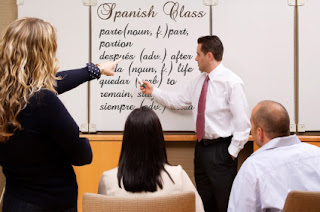
For many students studying Spanish, the ultimate way to test their speaking skills is to become immersed in a culture where it is the primary language. These days, student travel groups may be less inclined to visit Mexico, due to news of attacks on American citizens traveling there. Europe may be overpriced for smaller school trip budgets. Puerto Rico is a great alternative to other destinations. Best of all - no passport is needed, since it is a U.S. Territory.

If the school group leader requests it - this tour is done completely in Spanish. Students are challenged to speak Spanish while they travel. Student travelers will eat locally made Puerto Rican food, learn Salsa dancing from locals, play dominoes and briscas, dine and converse with local guides and residents and swim and lodge where locals enjoy the beach. Student travel groups will tour San Juan and Ponce, two of the largest cities in Puerto Rico, and also have the opportunity to explore rural areas, like the pristine beaches of Boquerón and Luquillo, the fishing village La Parguera, and El Yunque, the only tropical rainforest in the United States.

One of the best ways to improve one's speaking skills in any language is to listen to the native speakers. However, listening alone won't make you a great speaker. If you are looking for an effective method to improve your Spanish speaking skills, you should not only listen to native speakers, but also imitate them. What are the best methods to do it? Here are three of them!
1. Podcasts
There are dozens of podcasts online, just Google "Spanish podcasts". You can learn a lot from all of them. However, if you want to improve your speaking skills, you should look for the conversational ones. Try to find a podcast with a transcription, because it's better to improve speaking skills if you can follow the speaker while reading transcription. You can find a lot of podcasts on iTunes. Make sure that the podcast isn't too difficult for you since it's not effective to listen to something which you can't understand.

2. Lingus.tv
Lingus.tv is a web TV which is devoted to teaching Spanish in a very fun way - by sitcoms. These sitcoms last a few minutes, have a transcription, subtitles, there's a translation and grammar notes. Thanks to this, improving your Spanish is very easy - read a transcription and try to imitate native speakers' pronunciation. If you don't understand something, check the translation. You can improve your accent as well as vocabulary. These videos have three levels of difficulty - beginner, intermediate and advanced so you should find something suitable for you no matter how long have you been learning Spanish.

3. Audiobooks
Buy a regular book and an audiobook with a native Spanish speaker. Firstly, listen to a passage pronounced by a native Spanish speaker, then turn on your microphone and read the same passage aloud. Listen to your pronunciation and compare it to speaker's one. Repeat this process at least a few times to make your pronunciation as close to native speaker's as possible. Then, do the same for the next passage and the next one and so on. You can find a lot of books and audiobooks in Spanish on Amazon or eBay. Maybe your local library have some Spanish books?

Don't be discouraged if progress is slow. You can't improve your Spanish speaking skills overnight. Try methods listed above and I'm sure that after some time you will be speaking a lot better than you do now. Be determined and practice regularly. Good luck!
  

Apr 23, 2012

Tips For Effective Public Speaking To Develop Your Skills Right Away

Public Speaking
While a picture may be worth a thousand words, those words will no doubt come in handy if the picture is distorted or poorly understood. After all, the best way to communicate is through speech.

The four language skills of listening, speaking, reading, and writing are all interconnected. Proficiency in each skill is necessary to become a well-rounded communicator, but the ability to speak skillfully provides the speaker with several distinct advantages. The capacity to put words together in a meaningful way to reflect thoughts, opinions, and feelings provides the speaker with these important advantages.

Nothing is worse than standing on stage, your palms sweating, your throat tightening, tension gripping every fiber of your being while the eyes of every person in the room are locked on you. Though some people say that, with practice, public speaking gets easier, that really isn't the case. For most people, the fear and anxiety get worse every time they do it. So simple "practice" isn't enough, if you aren't correcting the other things in your preparation and execution to combat your anxieties. Here are 10 tips for effective public speaking to develop your skills right away.

#1 - KNOW THE MATERIAL: Preparation is the key to mastering public speaking. Don't settle for a few 3x5 note cards, and think that you'll do the actual phrasing on the fly. You will get flustered, your brain will lock up, and you will crash and burn. Try writing out your entire speech or presentation completely and tinker with it to get down the precise phrasing you want, and use this speech to cull a set of useful notes. Bring along a copy of the entire speech if you feel you need it, but remember to know your material thoroughly.

#2 - REHEARSE: Practice your entire speech from beginning to end several times, and include all visual aides or technical supplements you will be using (PowerPoint, slide show, video projector, etc.). By doing this, you will eliminate glitches and find places that need revision. Preparation is an essential public speaking skill to develop.

#3 - MINGLE FIRST: Try to get to know the audience before the speech, if there is any kind of mixer or reception beforehand. It's much easier to speak once you've generated some good will.

#4 - WALK-THROUGH: Get a feel for the auditorium or room where you will be speaking, examine the equipment, stand at the dais and get a feel for all of it.

#5 - RELAX: This tip may seem impossible, but it is absolutely vital to effective public speaking. Through concerted effort, try to channel your nervous energy into the speech.

#6 - IMAGINE SUCCESS: Visualize in your head beforehand what a successful speech will look like, and imagine yourself giving it.

#7 - THE AUDIENCE IS YOUR ALLY: Remember that the audience wants you to succeed. Nothing hits the gut more than watching a public speaker crash and burn, so know that the audience is rooting for you.

#8 - NO APOLOGIES: Begging forgiveness from the audience only draws attention to your failure, and chances are they didn't notice a wrong word choice or quick verbal stumble, so don't feel the need to say sorry.

#9 - FOCUS: A great public speaker is one who delivers the message with little attention drawn to himself. Focus on what you wish to present.

#10 - WATCH THE MASTERS: Try to find great speeches and addresses by great speakers and watch how they do it. Take notes. This is such a great public speaking tip.

Apr 17, 2012

Math Hard To Learn But Determined To Conquer

A difficult with math and numbers can be  described as dyscalculia. Dyscalculia is the name given to the learning disability in math. For a lot of children math will always be considered the toughest subject in school. Just the thought of having to remember everything the teacher tells them, all the math signs and processes is hard. And it does not get any easier as your child ages either. If you want your child to start doing better in class then it is time you help them better understand math. So why is math hard to learn
Mathematics is Abstract:
Mathematics is abstract. It does not have a shape. Children cannot see it. They need to visualize properly for solving a mathematical problem. Visualization comes from the everyday experience and relating mathematics with it requires a very strong trainer.
Present Teaching System:
Another major contributor to the difficulty of mathematics is lack of innovation in conventional system of teaching. The conventional system of teaching makes mathematics a dud and boring subject. Students are unable to visualize the concept taught by the teacher. Therefore, their interest level goes down. Hence they start developing a disassociation with the subject. If this disassociation continues for a longer period of time child starts hating mathematics.
This phenomenon of Math fear is growing everyday and now Central board has also recognized this problem. Through their circular they have asked the schools to create an environment where child takes interest in Mathematics.
Problem in converting word problems into mathematical equations:
Converting word problems into mathematical equation requires good understanding of the language and math fundamentals. Fundamentals are still taught in old-fashioned way in the school. Teachers teach fundamental without much of illustration therefore, students are not able to visualize the problem when they face it. They try to learn mathematics much like other subjects where they memorize facts and figures. Mathematics wants a thorough and good understanding.
Poor Command over Tables:
I interact with thousands of children every month. To my dismay I find that a good number of students show poor command over the tables. A few of them have gone to the higher classes say IX and X and still they rely on finger counting. When faced with multiplication like 18 × 7 they follow the complete multiplication steps to get the answer. Due to this Calculation takes more time and even a simple mathematics paper seems difficult to the students.
Here the question arises why do students have poor command over the tables? As far as my understanding goes we are moving towards Public School led education system and as we are anglicizing our education system more and more students are suffering from this syndrome. They have poor command over the tables because tables are not taught in mother tongue.
No system of Logic Development:
Our education system works on rote methodology. It tests you for how much you can cram before the examination day and vomit on the examination day. Mathematics does not work that way. It works on logic. In response to my question posted in a discussion group "Why did you fear Mathematics?" POOJA BHATNAGAR wrote: I dreaded mathematics! Would you believe if I told you that I actually got fever the night before my 10th boards maths exam !! I still managed a decent 83% though but the fear of maths........ Till date the numbers get mixed up in my mind! The fear actually came in pretty late, when we started handling the more complex calculations. Log tables never were any friendly to me. And assuming alphabets to be numbers again confused me to no end.
Poor Trainers:
Most of the time I find that the person teaching mathematics does not enjoy mathematics himself. If a math teacher does not enjoy mathematics then how can he create enjoyment for students?
Take the example of Dhyuti. She is a student of class-1. She is average in mathematics. Her mother was fed up with math teacher's remark on Dhyuti's notebook. She did not know how to improve her daughter's mathematics. One day she went to meet Dhyuti's Math teacher. During the discussion the math teacher revealed that she is a History graduate entrusted with the responsibility of teaching mathematics. She does not like teaching mathematics.
Effectively, in Dhyuti's class children developed a strong dislike for mathematics. Children are pure at their heart. Everything around them affects them. Be it dislike to mathematics shown by parents or teachers.
Calculation Takes Long time:
Samrana (Name changed) a class VI student from Gurgaon narrates his stories. He says that he is never able to understand mathematical concepts. He fears mathematics because of calculation. He hates numbers. It takes him a lot of time to add two numbers. He fears multiplication and division. He finds mathematics boring. It does not excite his imagination. But he enjoys games. He hopes against hope that one day his math learning would be full of fun.
Do not let dyscalculia haunt your child for the rest of their life. If you do not do something about it soon it will stick with them forever. So help your child get over their fear of math today. They will thank you in the future for helping them better understand how math works and how fun it is to solve a equation out

Apr 8, 2012

Effective Tips For Online Distance Learning

Online distance learning is gaining in popularity as the education method of choice for many students. However, it is still not as common as education obtained through traditional methods. There are several myths that are associated with obtaining an distance learning education. One of these myths is that online education schools are not as good as traditional schools. Online distance learning education can be as equivalently good as education obtained from a traditional school. The important thing to do is select the right online learning program. There are lots of quality programs that allow students to interact with specialist teachers and professors and learn through high-quality software.

Another common myth is that employers reject degrees from online distance education institutions. This is true for fake schools; however, there are plenty of accredited schools that offer online distance learning education opportunities and education from these accredited schools are accepted by employers. Many traditional colleges that have a distance learning program, and any certification awarded upon completion of such a program will not indicate that the courses were completed online.

Online distance learning education showed much progress in the recent decades. Aside from rapidly increasing online educational institutions, more and more traditional colleges and universities are offering programs to cater to the growing number of students who have realized the convenience, affordability and effectiveness of learning. If you think this method suits you well, there are things to consider before signing up for online learning programs.

First of all, choose an online course appropriately. Determine your goals and how a specific course would help you achieve those objectives. For instance, you could be employed and simply want a refresher course to brush up on the latest in the industry. In that case, a certificate course will suffice. For fresh high school graduates, advanced online learning programs are recommended for in-depth learning.

Keep in mind that the success of your education also depends on your fascination on the subject so make sure you will enroll in a course that you are genuinely interested in. Motivation is an important factor in any online distance learning endeavour since online distance learning programs offer so much flexibility that can easily lead to procrastination. A good tip to stay motivated is to set a study schedule and stick to it.

Having a dedicated study area also helps in learning education. It should be well-lighted with enough space for your computer and study materials. Use a chair you could comfortably sit on for hours. The area should also be away from distractions like television and food. Avoid doing household chores while studying so you can fully concentrate and complete your education on time.

Lastly, get support from instructors, classmates or even friends who share the same interest or are experts in the field. Although it is an education set-up, there is no need to study alone all the time. Make use of social media sites, forums and other venues where you could meet people who share the same interests and goals. In synchronous programs, you can meet and share with people who are taking the same course.

Lastly, get support from instructors, classmates or even friends who share the same interest or are experts in the field. Although it is an education set-up, there is no need to study alone all the time. Make use of social media sites, forums and other venues where you could meet people who share the same interests and goals. In synchronous learning programs, you can meet and share with people who are taking the same course.

In addition, the popularity of distance learning education has made it easy for students to locate a program that has been accredited by the professional industry association. This means, students can expect quality education from distance learning programs. It is not a far-fetched idea that online distance education is the future of learning.